
By Berrin Yesil (12th grade)
Editor’s note: I loved that Berrin tackled the fantastical topic of mermaids, so well suited to the seaside location of Burgas. By coincidence, the mermaid is the symbol of my home town Norfolk, Virginia, in the U.S. It seemed like a fitting homage from one city to another. P.S.
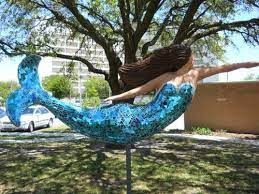
I’ve been interested in the question, “Do mermaids exist in real life?” since I was little, so I decided to do some research on whether mermaids really exist, and I can assure you that they really do exist, but we’re not looking in the right direction yet.
With most of our blue planet covered by water, it’s little wonder that, centuries ago, according to www.livescience.com, the oceans were believed to hide mysterious creatures including sea serpents and mermaids. Merfolk (mermaids and mermen) are, of course, the marine version of half-human, half-animal legends that have captured human imagination for ages.

Mermaids appear in the folklore of many cultures worldwide, including the Near East, Europe, Asia, and Africa. In ancient Assyria, the goddess Atargatis transformed herself into a mermaid out of shame for accidentally killing her human lover. Mermaids are sometimes associated with perilous events such as floods, storms, shipwrecks, and drownings (BigBlueByRoland St. John on Facebook).
In other folk traditions (or sometimes within the same tradition), BigBlueByRoland continues, they can be benevolent or beneficent, bestowing boons or falling in love with humans. The male equivalent of the mermaid is the merman, also a familiar figure in folklore and heraldry. Although traditions about and sightings of mermen are less common than those of mermaids, they are generally assumed to co-exist with their female counterparts. The male and the female collectively are sometimes referred to as merfolk or merpeople.
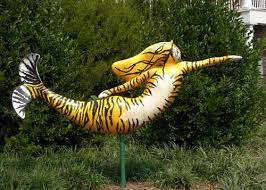
The conception of mermaids in the West, Wikipedia maintains, may have been influenced by the Sirens of Greek mythology, which were originally half-birdlike, but came to be pictured as half-fishlike in the Christian era. Historical accounts of mermaids, such as those reported by Christopher Columbus during his exploration of the Caribbean, may have been sightings of manatees or similar aquatic mammals.
While there is no evidence that mermaids exist outside folklore, reports of mermaid sightings continue to the present day, according to Wikipedia. Mermaids have been a popular subject of art and literature in recent centuries, such as in Hans Christian Andersen’s literary fairy tale “The Little Mermaid” (1836). They have subsequently been depicted in operas, paintings, books, comics, animation, and live action films.

I think they are an important part of our life because they can help us as long as we treat them in a friendly way and show them respect and ensure their safety. My interest in them started after watching the 2008 film “H2O”. I’ve always loved to swim and to spend my day in water and also I have really improved my Sixth Sense with which I can have really strong vibes of telepathy or feel an upcoming event. Maybe that is why mermaids impressed me. Not because of their tail, but because people tend to neglect them or think about misusing them if they were alive. I think this is also a kind of harsh racism towards those creatures.
I interviewed my friends from different nationalities about this topic and the results of this survey showed that people divide 50/50 about whether they believe mermaids really do exist. What follows are some of people’s positive answers because for me there is no point in showing people’s answers who think that mermaids are just an illusion and don’t exist. For example, my friend Romit, who is 15 years old from India, answered that all he knew about mermaids is that they are bad because they would seduce male soldiers with their beauty and eat them. He added that he doesn’t have a clue about their existence but there were endless possibilities. In the end he said that if they existed, he would make them be on good terms with people and would promote research on them.
Another friend from Malaysia, called Ikin, who is 16 years old, answered that they would be friendly if people treated them with patience and walked slowly without scaring them; she added that she really believes in their existence but thinks that their appearance can be ugly. Another person, Bella from Canada, agreed that mermaids are still alive and are friendly, but she also admitted that she would do nothing if mermaids were found out to be real.

William R. Mistele, a philosopher who has researched mermaid traits, http://www.williammistele.com/finaltraits1019.htm, describes how he came up with his theory that there were a few women who were once mermaids in other lifetimes. They have since acquired human souls under various circumstances and are now incarnate as human beings.
Mistele is the author of such books as “Mermaid, Sylphs, Gnomes and Salamanders.” He’s a spiritual anthropologist who researches other realms where we discover the keys to what is missing from life. He claims to have interviewed three such mermaid women. There were very rare instances of a mermaid entering a human child at birth, he says. That’s why mermaids could be hypersensitive. They could understand each person’s feelings as if they were in that person’s body. That describes why they could feel very clearly as humans including all the environment’s positive and negative energies. Also, Mistele says, mermaids can have a strong telepathy with a human being they’ve chosen, no matter where he/she is from.
According to his research, in spite of their profound empathy and capacity to join with others from within, mermaid women feel detached from other people no matter how strong the relationship or how involved they are with others. They feel they are observing life from a distance. At the same time, they do not feel alienation or isolation. They are content and enjoy being independent.

For many mermaid women, “Time in the outer world is not real,” Mistele writes. “There is no past, present, or future.” Linear time does not exist. They feel they are a part of nature. They have a nonhuman identity. Some aspect or element of nature is alive within them, and that is who they sense they really are.
As for me, I think that mermaids save people’s lives. For example, when a shipwreck happens, usually one or two people, or at least a few people are rescued. I don’t think that this is a coincidence at all. OK, those rescued ones maybe had some luck, but I don’t think that they were saved without any help. What do you think about it?
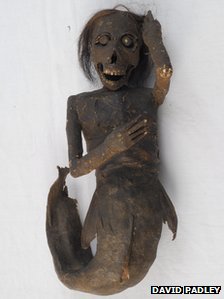
Also, as to mermaids’ sensitivity, they don’t have telepathy with one person but they live the emotions of people as if they switched their bodies. I think that they can choose whether to help that person or to die. That is why my hopes are up that they exist otherwise we wouldn’t imagine them or read about them. Even there is a museum in the U.K. with a mermaid skeleton.